
Machining Manufacturer: Machined Parts
Geometry is the single largest driver of a delivery date, because geometry sets the number of operations and setups. A simple round spacer needs one turning operation and one inspection. A prismatic housing with pockets, bores, and threads needs several milled setups, each with its own fixture, program, and tool change. The part did not get harder to describe — it got harder to schedule.
That is why a serious manufacturer ties the quote to the process count rather than the shape. A complex part can run 10–20 process steps, and every step is a unit of time: setup, cutting, deburring, inspection, and — if it leaves the building — waiting at a secondary operation. When a shop quotes the same "two weeks" for a spacer and a 12-operation housing, it has not looked at the geometry; it has looked at the calendar.
Geometry also decides how many fixtures the part needs, and fixtures are hidden schedule. A part that can be machined in one or two clampings moves through the floor quickly; a part that must be flipped and re-fixtured for every face accumulates setup time that never shows up as cutting. When you read a quote, the number of setups is as informative as the number of steps — it tells you how many times the part stops moving while the shop prepares to cut it.
How Does Material Choice Affect Your Delivery Date?
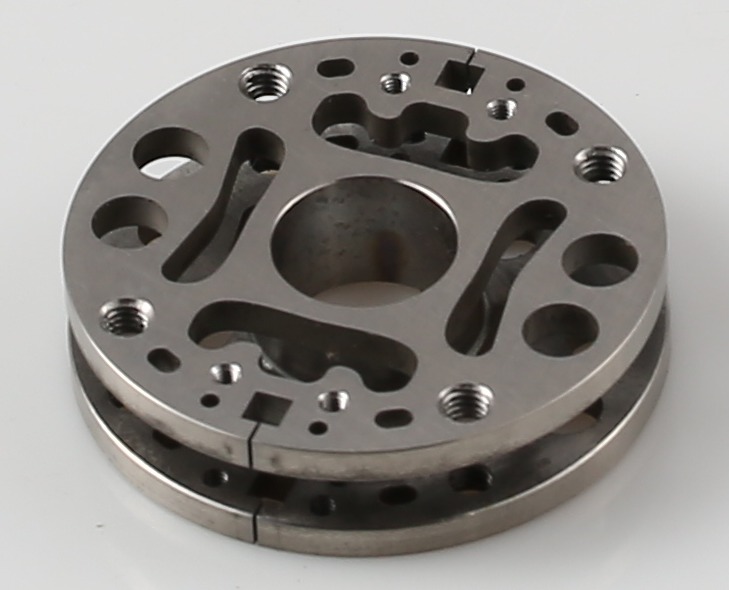
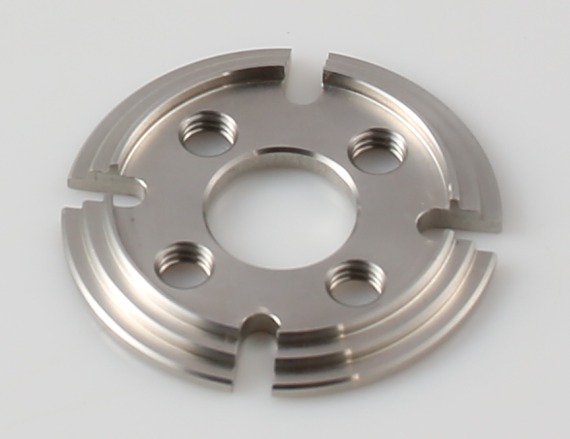
Material affects the schedule in two ways, and you should know both before committing. First, availability: common alloys are carried in stock and cut the day the order lands, while an uncommon grade has a procurement lead time that runs before the first chip. Second, machinability: free-machining materials cut fast, while hard or gummy alloys force slower feeds and more tool changes, and that time shows up in the date.
| Material family | Typical grades | What it means for schedule |
|---|---|---|
| Aluminum | 6061, 6063, 6082, 7075 | Fast cutting, usually in stock; anodizes well |
| Stainless steel | 303, 304, 316, 316L, 17-4PH | Slower than aluminum; 303 is the free-machining choice |
| Carbon / alloy steel | 1018, 1045, 4140, 4340, 12L14 | Readily available; carburizing or nitriding adds a step |
| Brass / copper | C360, H62, C110 | Fast cutting, good for electrical and thermal parts |
| Titanium | TA2, TC4 | Slow cutting; stress relief above 500 °C is outsourced |
Stating the alloy precisely in your RFQ — "6061-T6," not "aluminum" — lets the shop check stock and quote a real date. A vague material spec is one of the most common reasons a promised delivery date slips, because the factory discovers the true requirement only after the order is already in motion.
What Tolerances Can You Specify Without Blowing the Schedule?
Tolerance is where precision and schedule trade against each other. A tight tolerance on a bearing bore is worth every minute it costs, because the bore controls function. The same tightness on a cosmetic edge buys nothing and costs cutting time, inspection time, and scrap — all of which push the part toward a longer lead-time tier.
| Process | Held tolerance | What it costs the schedule |
|---|---|---|
| CNC milling | ±0.003 mm | Critical features only — selective tolerancing keeps it fast |
| CNC turning | ±0.002 mm | Standard for round parts without added time |
| Precision grinding | ±0.002 mm | Adds a finishing operation and its own lead time |
We hold these to process capability, not to a best case. On a representative length characteristic (76.1–76.5 mm), our SPC shows Cpk = 1.851 (one characteristic on one part, not a blanket capability claim) against an initial-study target of Ppk ≥ 1.67. Your lever is selective tolerancing: mark the few features that control function, let the rest ride at general tolerance, and the part ships faster without giving up a thing that matters.
Read the tolerance band before you read the index. Cpk is a ratio of the tolerance band to the process spread, not an absolute measure of accuracy. The figure above was recorded on a length characteristic with a 0.4 mm band (76.1–76.5 mm) — wide by design. Hold the same process spread against a ±0.005 mm feature and it fails outright. Ask for the band, the subgroup count and the sampling window on every capability number a supplier quotes.
There is a second cost hidden inside a tolerance call-out: inspection. Every tight dimension must be measured, and measurement is time on the CMM or the bench that could have gone to the next order. A part with one toleranced bore is quick to prove; a part with twenty toleranced dimensions is a part that spends as long being checked as it does being cut. Tolerance the features that earn it, and the inspection load — and the schedule — stays proportionate to the function.
How Are Many Part Numbers Scheduled on One Floor?
A machining manufacturer never works on your part alone — it is always running a portfolio, and your part competes for machines, fixtures, and programmers against every other job in the building. The difference between a supplier that ships on time and one that does not is whether it schedules that portfolio or simply queues it.
Scheduling runs on three levers. Machine availability — with 50+ 3-axis centers and 25+ lathes, a new part can usually find an open machine without displacing existing work. Setup time — a part that needs a new fixture and program costs the shop a morning, and that morning appears in your date. Material arrival — stock alloy starts the day the order lands; a special grade waits for its own lead time. A manufacturer that plans all three can tell you, in advance, where your part sits and when it ships.
How Do Secondary Operations Change a Delivery Date?
Secondary operations are where the promised date most often breaks, because they are the steps that leave the building. Anodizing, plating, and outsourced heat treatment each add their own queue, and if you were not told about them, you discover the true lead time only when the part is already sitting at a plating shop.
- Surface finishing: standard and hard anodizing, zinc / nickel / silver / gold / chrome plating, powder coating, painting, brushing, and mirror polishing.
- Heat treatment: vacuum, bright, carburizing, nitriding, and stress-relief aging. In-house ovens reach 500 °C; titanium stress relief above that goes to a qualified partner.
- Deburring, tapping, laser marking, and assembly: bundled as the drawing requires.
Honest schedule rule: a part with surface finishing falls into the longer ~30-day tier, and the finishing days should be in the quote. If a supplier's number does not mention finishing, the number is not the whole story.
What Should a Buyer Specify to Keep a Part on Schedule?
The fastest way to a late part is an incomplete RFQ, because every missing field is a question the factory has to ask, and every question is a delay. Four fields, sent together, let a manufacturer place your part in the schedule on the first pass.
- Geometry: a STEP or IGES file plus a 2D drawing with tolerances on critical features only.
- Material: the exact alloy and condition — "6061-T6," "316L," "TC4."
- Finish: as-machined, anodized, plated, or coated, and which surfaces.
- Quantity: per order, plus annual volume so the shop can plan the ramp.
Then hold the date you get back to the same standard: ask which machines run the part, how many steps it has, and whether any step is outsourced. A CNC machined parts manufacturer that answers those questions is giving you a schedule you can write into a purchase order and expect to keep.
How Do Part Features Stack Into Process Steps?
A part's delivery date is mostly decided by the features printed on it, because each feature class maps to a process step. A hole maps to drilling; a pocket maps to milling; a thread maps to tapping; a bearing bore maps to boring and often grinding. Count the feature classes and you have a first estimate of the process count, and the process count is the lead time.
This is why two parts of the same envelope can land in different tiers. A flat plate with a few holes is a two-step part and sits in the ~3-day tier. The same-sized plate with pockets, threads, and a toleranced bore is a six-step part and sits in the ~7-day tier. The schedule is not set by how big the part is; it is set by how many different operations the features demand.
your lever is to let the features do only the work the function needs. A through-hole that could be drilled does not need to be bored; a cosmetic edge does not need a tight tolerance; a tapped hole that carries no load does not need a special thread class. Every feature simplified is a step removed, and a step removed is time given back to the schedule.
What this shop actually runs
If you ask for capability evidence, you deserve a specific answer. This facility operates 100+ CNC machines across 6,800 m2 in Dongguan, China, staffed by 100+ people. The machines, listed by category:
- 5-axis machining centres (10+) - Mazak VARIAXIS I-600 (510/910/510 mm travel, 12,000 rpm, 22 kW, 71.6 N·m, 30-tool BT40) and Mazak INTEGREX I-250H S (B-axis 0.0001°, 24 kW, 124 N·m, 38-tool HSK-A63). Typical work: compound-angle parts, single-setup multi-face prismatic work, and aerospace fittings where datum transfer loss is unacceptable.
- 3-axis / 4-axis machining centres (50+) - Brother SPEEDIO S500Z2N / S700Z2N (10,000 rpm, 14/21-tool ATC, 0.7 s tool-to-tool, Z-axis 2.2 G) and Mazak VCE-430A L / VCE-570C L (10,000 rpm, 118 N·m, 24-tool ATC). Typical work: prismatic parts, plates, brackets, housings.
- Swiss-type turning centres (10+) - Citizen Cincom A20-3F7 (Φ20 mm, 10,000 rpm), TSUGAMI B0206-III / B0205-III (Φ20 mm, 0.1 µm), STAR SR-32JII / SR-32J Type N (Φ32 mm, 8,000 rpm). Typical work: long, slender rotational parts at ±0.002 mm.
- CNC turning centres (20+) - HEADMAN T70M/1250 (720 mm swing, 117 mm bore, 3,000 rpm, BMT75 12-station turret). Typical work: shafts, bushings, flanges up to ±0.002 mm.
- Wire EDM (5+) - Sodick AQ535L (550/350/300 mm travel, ±20° taper, 800 kg workpiece). Typical work: hardened tool steel, internal splines, sharp internal corners that milling cannot reach.
- Inspection: Hexagon CMM + 20+ gauges - Hexagon CMM for coordinate measurement, plus vision system, profilometer, hardness tester, coating thickness gauge, XRF for material verification. The 10:1 rule (gauge 10x more accurate than the band) is applied to every feature.
- Machine highlights - VARIAXIS I-600: one-setup multi-face 5-axis + MAZA-CHECK auto-calibration; INTEGREX I-250H S: DONE-IN-ONE mill-turn, B-axis 0.0001° + Ai thermal shield; SPEEDIO S500Z2N / S700Z2N: Z-axis 2.2 G + 0.7 s ATC; Swiss-type: guide-bush switchable + 0.1 µm resolution.
Tolerance bands: ±0.003 mm milled, ±0.002 mm turned, ±0.002 mm ground or wire-cut. Capability indices: Ppk >= 1.67 at the initial study; Cpk >= 1.33 ongoing in production.
Certifications: ISO 9001:2015 (116024/A/0001/UK/En) · IATF 16949:2016 (131941/A/0001/SM/En, design clause 8.3 excluded) · ISO 14001:2015 (116024/B/0001/UK/En), held by Dongguan Zhuohang Ltd (USCC 91441900MA4UWT6X39, since 2005).
Service area: we supply Austria, Belgium, the Czech Republic, Denmark, France, Germany, Greece, Hungary, Ireland, Italy, the Netherlands, Spain, Sweden and the United Kingdom in Europe; Brazil, Canada, Mexico and the United States in the Americas; China, Israel, Japan, Singapore and Sri Lanka in Asia; Australia and New Zealand in Oceania; and South Africa in Africa, with worldwide delivery from China.
Contact: Felipe Iglesias, [email protected], +86 13126536955.
Get a lead time tied to your part, not to a calendar
Send your drawing, material, and finish to [email protected] or call +86 13126536955 for a quote that names the process steps behind the date.
Frequently Asked Questions
Which part families does this manufacturer run?
Milled parts, turned parts, mill-turn parts, and ground parts. The floor covers 3-axis, 4-axis, and 5-axis milling, turning, mill-turn, and grinding, so most parts are completed under one roof instead of being shipped between subcontractors.
How does part geometry affect lead time?
In short, Geometry drives the number of operations and setups a part needs. A simple round part may take one turning operation, while a prismatic part with pockets, holes, and threads needs several milled setups — each setup adds time that should appear in the quoted date.
How does material choice affect delivery?
Material affects both machining speed and stock availability. Common alloys like 6061 aluminum and 303 stainless are usually in stock and cut quickly, while titanium or an uncommon grade can add procurement time and slower cutting to the schedule.
Can you specify tight tolerances without delaying the part?
In short, Yes, if tolerances are applied only to the features that control function. Tight tolerances on a few critical dimensions add inspection time; tight tolerances on every dimension slow cutting and raise scrap for no functional gain, and push the part into a longer lead-time tier.
How are many part numbers scheduled on one floor?
In short, Part numbers are scheduled around machine availability, setup time, and material arrival rather than a first-come queue. With over a hundred machines and redundant capacity, a new part number can be slotted in without displacing the orders already running.
Do secondary operations change the delivery date?
In short, Yes. Anodizing, plating, and heat treatment that leave the building add days to the schedule.
How do part features map to process steps?
In short, Each feature class maps to an operation: a hole to drilling, a pocket to milling, a thread to tapping, a bearing bore to boring and often grinding. Count the feature classes and you have a first estimate of the process count, and the process count is the lead time.
How can I design a part for a faster delivery?
In short, Let the features do only the work the function needs. Use a drilled through-hole instead of a bored one where it can work, keep tight tolerances off cosmetic surfaces, and simplify threads that carry no load.
Standards referenced on this page
- ASTM B211/B211M-19 — Standard Specification for Aluminum-Alloy Rolled or Cold Finished Bar, Rod, and Wire
- ASTM A582/A582M-12 — Standard Specification for Free-Machining Stainless Steel Bars
- ISO 9001 — Quality management systems — Requirements